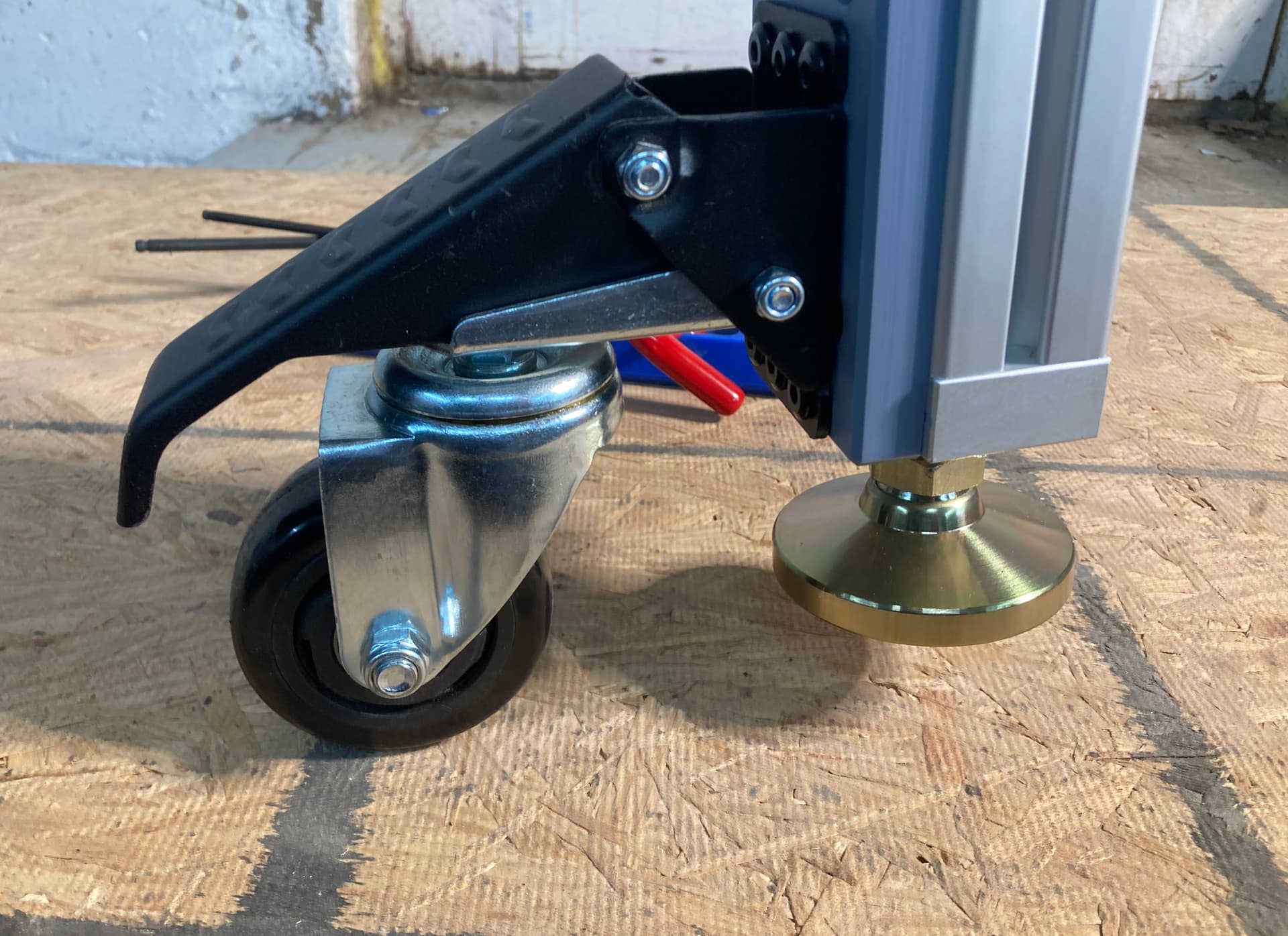
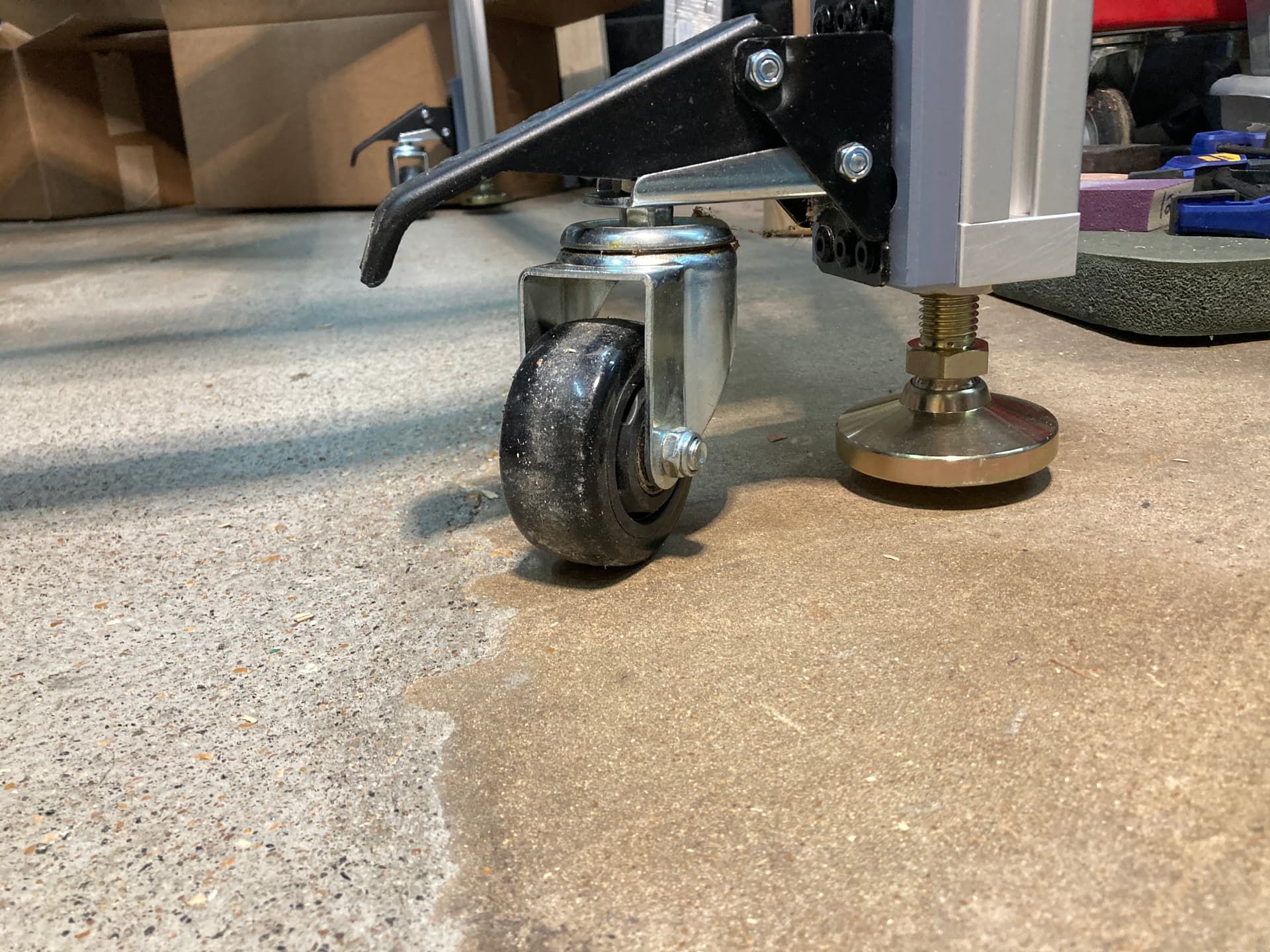
TL;DR: Link below to the 3D model and CAD files for a Dominator Pro adapter plate that lets you attach common retractable caster wheels.
Problems
- I need to move my CNC machine, but only once or twice per year, so I want both leveling feet and wheeled casters.
- Hard to find (economical) leveling casters with 20mm threaded posts that the Dominator Pro uses by default.
- Leveling casters with flat plates would require a different base plate from 80/20, and I want to keep the current leveling feet.
- I already have retractable casters from my heavy wood table (~250-300 lbs.) used with my previous CNC. They have worked very well for years. Product name for reference:
”SPACEKEEPER Workbench Casters Kit rated for eight hundred eighty pounds, three inch heavy duty retractable casters.” https://www.amazon.com/dp/B08FDFJXK5?th=1
Solution
Design an adapter plate that attaches the existing casters to the 40x80mm extrusion legs on the Dominator Pro.
What I found is that the 3D printed test adapter plate worked perfectly when printed with the “Strength” profile in Bambu Studio! These plastic plates are surprisingly more than strong enough. Just to note, I also exported a STEP file and got a quote from Send Cut Send to make them in 1/4" 6061 aluminum with tapped holes, countersinking, and clear anodizing. The quote came out to about $34 each, which is not bad, but I did not want to wait the ten days for delivery. And, I also did not want to order the countersunk cap head screws from 80/20, since I already have 8mm flat cap head screws from Amazon for much less. If you prefer aluminum, the STEP file is included in the download package.
Also, I had to raise the bottom shelf of the Dominator Pro leg kit by two inches to right at 10" instead of eight. This gives the caster foot paddles room to operate. It also lets me mount the casters on the inside of the profile so they are not a tripping hazard and the result looks cleaner. If you are retrofitting an existing setup, you can use “Roll-In” T-Nuts and place the adapter plate on the outside of the extrusion.
Pros
- 3D printed parts can be both functional and strong.
- Quick and easy to reprint if you need to remove and reinstall later.
- Customizable for different casters in the future.
- Secured by four 8mm T-Nuts that hold very well.
- Works with the existing 80/20 leveling feet and base plates.
Cons
- It is plastic. Do not plan to detach and reattach the casters repeatedly. The six threaded holes for the caster machine screws will strip out once you remove them the first time. You could possibly use coarse threaded wood screws for better grip.
- You cannot extend the leveling feet too far or they will sit lower than the caster wheels, and you can’t retract them too much before the wheels in the collapsed mode will still touch the floor.
- It may not look professional, but I am not trying to show off the machine. I care about what it helps me produce.
Download
Here is the link to download the 3D model (STL file), STEP file and FreeCAD drawing:
Here’s the eye candy: